692 hearts
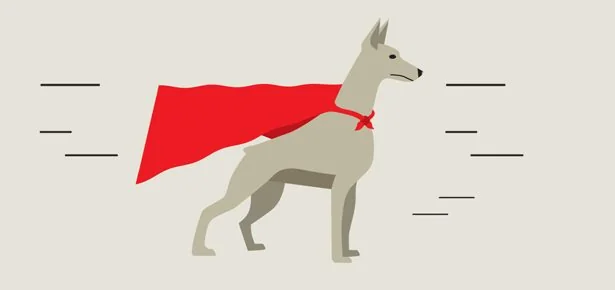
Imagine: you're a dog. Your owner is trapped in a box, crying for help. Do you pick up on their panic? If so, can you set them free—and, more importantly, do you actually want to?
That's exactly what Joshua Van Bourg and Clive Wynne set out to discover when they gave dogs the chance to rescue their owners.
Until recently, very little research existed on dogs' interest in rescuing humans, yet it's long been something we expect from our canine companions—a legend that stretches from Lassie all the way to the animated hero Bolt.
'It's a pervasive legend,' said Van Bourg, a graduate student in Arizona State University's Department of Psychology.
Watching a dog rescue someone doesn't tell you much, Van Bourg explained. 'The difficult challenge is figuring out why they do it.'
So Van Bourg and Wynne—an ASU professor of psychology and director of the Canine Science Collaboratory—designed an experiment measuring 60 pet dogs' tendency to rescue their owners. None of the dogs had any rescue training whatsoever.
In the main test, each owner was shut inside a large box fitted with a lightweight door the dog could push aside. The owners feigned distress, calling 'help' or 'help me.'
Beforehand, the researchers coached the owners so their pleas sounded genuine. The owners were also forbidden from calling their dog's name, which would have nudged the dog to act out of obedience rather than out of genuine concern for their wellbeing.
Cognitive-canine expert Clive Wynne poses with one of his utterly adorable research pals. (Photo: Deanna Dent/ASU Now)

'About one-third of the dogs rescued their distressed owner, which doesn't sound too impressive on its own, but really is impressive when you take a closer look,' Van Bourg said.
That's because two things are at play. One is the dogs' desire to help their owners. The other is how well each dog understood what kind of help was even needed. Van Bourg and Wynne untangled this in control tests—a step previous studies had skipped.
In one control test, when the dog watched a researcher drop food into the box, only 19 of the 60 dogs opened it to grab the food. In other words, more dogs rescued their owners than retrieved food.
'The key here is that without controlling for each dog's understanding of how to open the box, the proportion of dogs who rescued their owners greatly underestimates the proportion of dogs who wanted to rescue their owners,' Van Bourg said.
'The fact that two-thirds of the dogs didn't even open the box for food is a pretty strong indication that rescuing requires more than just motivation—there's something else involved, and that's the ability component,' Van Bourg said. 'If you look at only those 19 dogs that showed us they were able to open the door in the food test, 84% of them rescued their owners. So, most dogs want to rescue you, but they need to know how.'
In another control test, Van Bourg and Wynne watched what happened when the owner sat calmly inside the box reading aloud from a magazine. What they found: four fewer dogs—16 out of 60—opened the box in the reading test than did in the distress test.
'A lot of the time it isn't necessarily about rescuing,' Van Bourg said. 'But that doesn't take anything away from how special dogs really are. Most dogs would run into a burning building just because they can't stand to be apart from their owners. How sweet is that? And if they know you're in distress, well, that just ups the ante.'
The fact that dogs opened the box more often during the distress test than the reading control is strong evidence that rescuing can't be explained by the dogs simply wanting to be near their owners.
Video supplied by Clive Wynne.
The researchers also monitored each dog's behavior across all three scenarios, watching for stress signals like whining, pacing, barking, and yawning.
'During the distress test, the dogs were much more stressed,' Van Bourg said. 'When their owner was distressed, they barked more, and they whined more. In fact, there were eight dogs who whined, and they did so during the distress test. Only one other dog whined, and that was for food.'
What's more, the second and third attempts to open the box during the distress test didn't leave dogs any calmer than the first attempt. That was a sharp contrast to the reading test, where dogs already exposed to the scenario grew less stressed with repetition.
'They became acclimated,' Van Bourg said. 'Something about the owner's distress counteracts this acclimation. There's something about the owner calling for help that makes the dogs not get calmer with repeated exposure.'
Taken together, these behaviors are more evidence of 'emotional contagion'—the transfer of stress from owner to dog—which Van Bourg says is what humans would simply call empathy.
'What's fascinating about this study,' Wynne said, 'is that it shows that dogs really care about their people. Even without training, many dogs will try and rescue people who appear to be in distress—and when they fail, we can still see how upset they are. The results from the control tests indicate that dogs who fail to rescue their people are unable to understand what to do—it's not that they don't care about their people.'
'Next, we want to explore whether the dogs that rescue do so to get close to their people, or whether they would still open the box even if that did not give them the opportunity to come together with their humans,' Wynne added.
The study, 'Pet dogs (Canis lupus familiaris) release their trapped and distressed owners: Individual variation and evidence of emotional contagion,' was published online last month in the journal PLOS.
By clicking the arrow, you agree to our web Terms of Use and Privacy & Cookie Policy. Easy unsubscribe links are in every email.
keep the journal open